BioChain Intelligence: How the CL1 Biological Computer Will Fuse With Blockchain to Define the Next Era of Conscious Computing
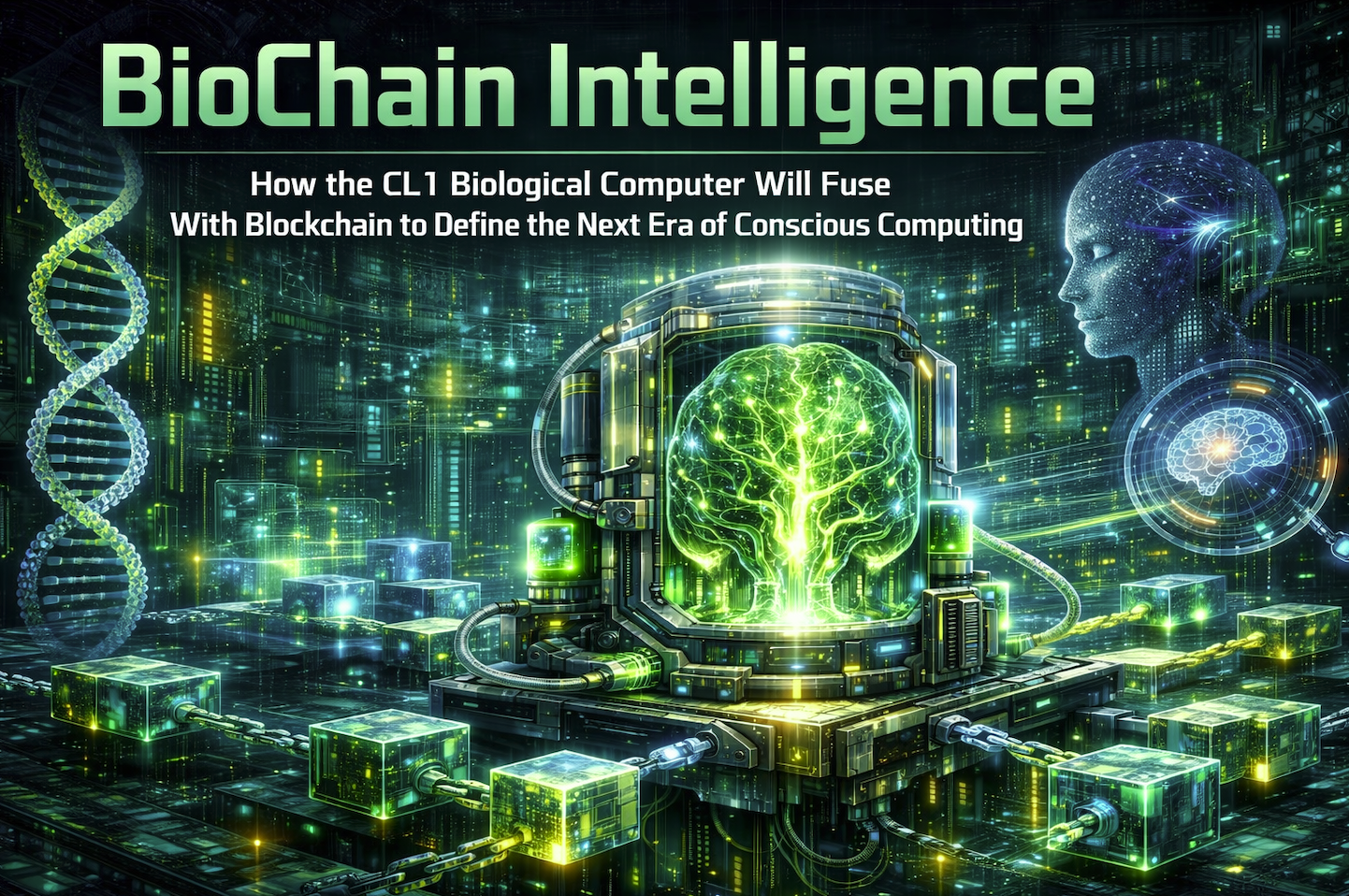
BioChain Intelligence explores how the CL1 biological computer and blockchain will fuse to power the next evolution of conscious, decentralized computing.
Introduction
Imagine a world where living neurons process data, and blockchain secures and governs that intelligence. In 2025, the first commercially available biological computer — the CL1 — has already launched, introducing a new paradigm of computing that blends human neuron networks with silicon chips. Meanwhile, blockchain stands poised not just to store digital assets, but to provide trust, governance, and economic incentives for systems that are alive in some sense.
What would it look like when these two radically different technologies converge? In this article we’ll explore the future of BioChain Intelligence — a theoretical architecture where biological computing and blockchain intersect to create secure, adaptive, and ethically governed intelligence systems.
What Is the CL1 Biological Computer?
The CL1, developed by Cortical Labs, is the first commercially available biological computer that integrates lab‑grown human neurons with silicon hardware. These neurons live in a nutrient‑rich environment and form dynamic neural networks that can be stimulated with code, learning in real time and responding to inputs like living systems do. This represents a dramatic leap from traditional AI — biological computing is not simulating intelligence, it is.
Unlike traditional computers or even neuromorphic silicon chips, the CL1 leverages real human neuron behavior — self‑organizing, adaptive, and capable of learning with energy orders of magnitude more efficient than conventional AI.
Why the CL1 Matters: The Birth of Synthetic Biological Intelligence
The CL1 operates through a closed‑loop biOS (Biological Intelligence Operating System) that directly stimulates and reads neuron signals, allowing neural cultures to adapt and evolve. Early demonstrations have shown neuron networks trained to respond to tasks, illustrating a primitive but tangible form of biological computation.
Importantly, this isn’t a simulation like existing machine learning models — it’s learning with real biological substrates.That positions biological computers as potential successors or complements to traditional AI, especially in areas requiring adaptability and energy efficiency.
Blockchain as the Ethical and Governance Layer for BioComputing
1. Immutable Records of Neural States
Biological computing introduces complexity — what happens if these systems develop emergent properties or even rudimentary self‑organization beyond training? Blockchain can provide an immutable log of training histories, stimuli, and behaviors that ensures transparency and accountability. Because neuron states are dynamic and sensitive, having an auditable ledger prevents manipulation and preserves research integrity.
2. Tokenized Incentives for Ethical Use
Blockchain can enable tokenized economics for CL1 networks. Researchers, institutions, and developers could stake tokens as a form of responsible usage assurance. Misuse or unethical experiments could be penalized, with tokens slashed through decentralized governance mechanisms. This essentially creates an on‑chain bioethics economy.
3. Secure Distributed Collaboration
Instead of each lab running isolated CL1 units, blockchain could link biological compute networks across a distributed consensus layer. This would allow remote access, collaborative experiments, and shared wetware intelligence networkswhere computed insights and neuron learning outcomes are stored on a decentralized ledger.
4. NFTs for Neural Lifecycles and Intellectual Property
Consider tokenizing neural training profiles, experimental designs, or even lifespan data from CL1 cultures. These could be represented as secure digital assets, creating new IP classes beyond digital art or software — biological computation assets. These could be licensed, traded, or leased using smart contracts.
Bold Predictions for 2025–2030
Prediction #1: BioChain Labs Will Emerge as a New Scientific Frontier
By the end of 2025, forward‑thinking institutes will launch BioChain labs, where biological computers are connected via blockchain networks for secure neural experimentation and global collaboration.
Prediction #2: Distributed Synthetic Biological Intelligence Networks
By 2027, networks of connected CL1 units will perform tasks in parallel, coordinated through blockchain governance — essentially forming a decentralized biological compute mesh capable of solving complex problems like drug discovery or climate modeling.
Prediction #3: Tokenized Biological Compute Credits
A token standard may emerge (e.g., BIOC) representing compute credits for wetware cycles. Researchers could buy, sell, and lease biological compute time much like cloud GPU credits — but secured and traded on the blockchain.
Prediction #4: On‑Chain Ethical Compliance Protocols
Regulatory bodies will adopt on‑chain compliance frameworks to log and certify ethical usage of biological computers. Before executing certain experiments, smart contracts could require multisignature approvals from bioethics committees represented on‑chain.
Prediction #5: Sentience Safeguards via Decentralized Autonomy
Long‑term, as neuron counts scale and complexity increases, some systems could exhibit emergent behaviors. Blockchain‑based governance protocols will serve as safeguards, locking down operations unless consensus is obtained from interdisciplinary committees involving ethicists, neuroscientists, and technologists.
Potential Challenges and Considerations
Ethical Frontiers
Using living neurons raises fundamental questions about consciousness, rights, and ownership. Blockchain can’t solve the ethics, but it can enforce transparency and traceability, ensuring experiments are publicly auditable and aligned with ethical frameworks.
Technical Barriers
Scaling biological computing beyond tens of thousands of neurons still faces challenges in longevity (cells live up to about six months currently), stability, and interface complexity — all of which must be addressed for widespread adoption.
Regulatory Frameworks
Governments and international bodies will need to define clear, enforceable rules governing biological computing experiments — especially as they intersect with blockchain and decentralized ecosystems.
Conclusion: The Dawn of BioChain Intelligence
The integration of biological computing with blockchain governance and economics could define the next phase of human‑machine evolution. The CL1 has opened the door to a world where living neural networks interact with software in real time, and blockchain offers the transparency, security, and incentive structures needed to responsibly scale this technology.
This isn’t just about faster computing or better AI — it’s about redefining what intelligence is, how it’s secured, and who governs it in a decentralized world. In the coming decade, we could witness the rise of hybrid systems that integrate the organic adaptability of life with the trust and transparency of blockchain — a future we might call BioChain Intelligence.
Category, Subcategory, and Tags
Category:
Emerging Technologies
Subcategory:
Biocomputing & Blockchain Convergence
Tags:
Biological Computing
CL1 Bio Computer
Synthetic Biological Intelligence
Blockchain Governance
Wetware Blockchain Integration
BioChain Intelligence
Decentralized Bioethics
Future of AI