Digital Twins + Blockchain: How Blockchain Will Power Personalized Virtual Replicas of Everything
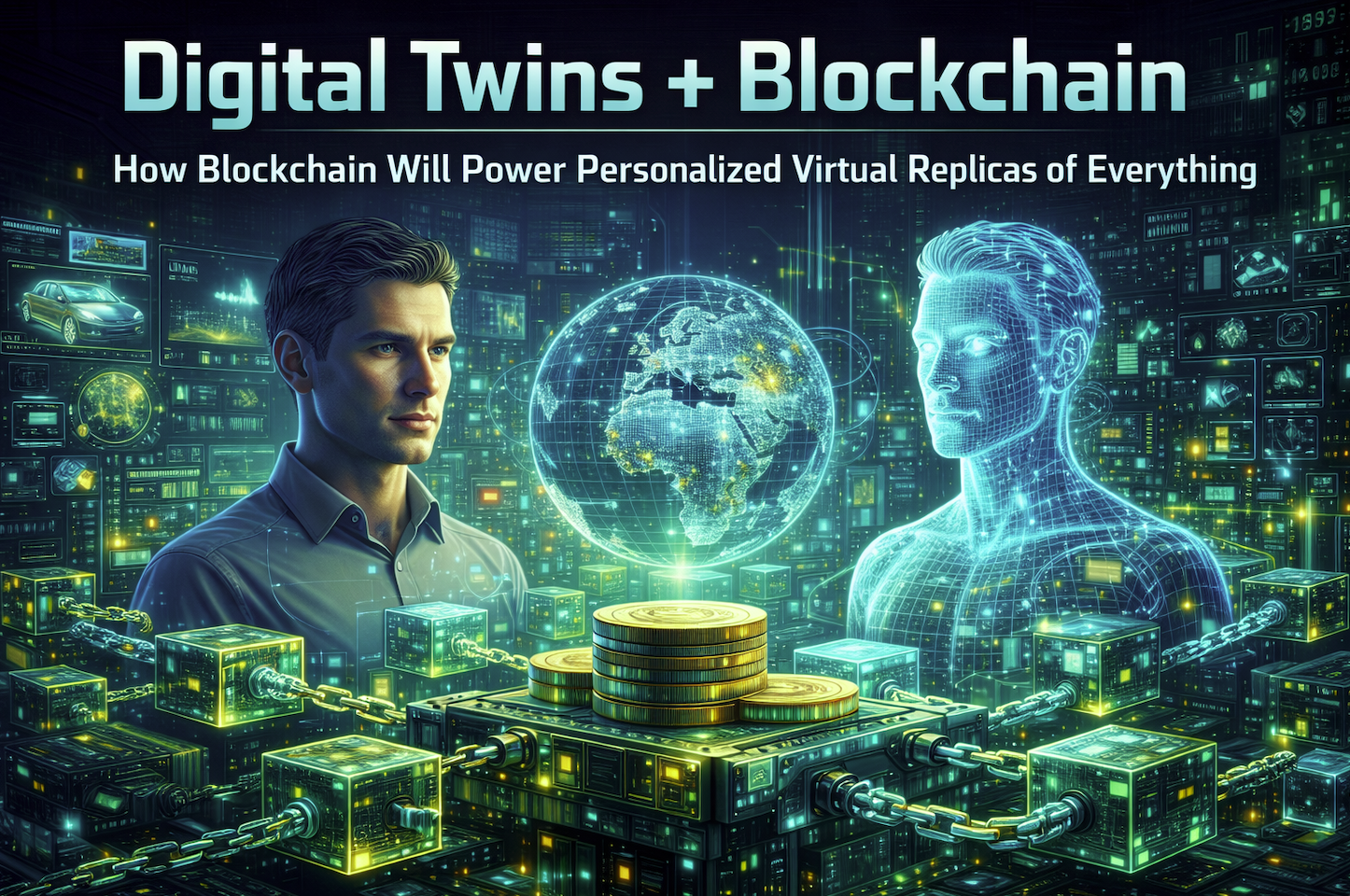
This image captures how blockchain technology enables personalized digital twins—real-time virtual replicas of people, products, and systems—ushering in a new era of smart, decentralized identity and data management.
We’ve heard of digital currencies. We’ve even heard of digital art, digital IDs, and digital land. But what happens when we move beyond “digital assets” and start creating digital realities—living, evolving, mirrored replicas of every important thing in the real world? And what happens when we secure those replicas with blockchain?
Welcome to the next frontier in technology: Digital Twins secured by blockchain—a concept that is quietly emerging from labs, city planning offices, and industrial giants, and which will redefine how we build, simulate, and manage the world around us.
This is not science fiction. It is already happening. And it could create a trillion-dollar shift in how we interact with objects, systems, environments, and even ourselves.
What Are Digital Twins?
A Digital Twin is a virtual representation of a real-world object, system, or process. It is continuously updated with real-time data from sensors, devices, or simulations, mirroring its physical counterpart in structure, condition, and behavior.
Real-World Examples (Already in Use):
Airbus uses Digital Twins to monitor the health of aircraft engines.
Singapore runs a full-scale 3D twin of the entire city to simulate traffic flow and energy usage.
Siemens uses twins in factory environments to test machines virtually before deployment.
These applications are proving that Digital Twins can reduce costs, predict failures, and optimize systems in real time. But the next stage—the one nobody’s talking about—requires blockchain to fully scale, secure, and decentralize this ecosystem.
Why Digital Twins Need Blockchain
Digital Twins today are powerful, but they’re fragile. Their data can be siloed, manipulated, or lost. Ownership is often unclear. Security is an afterthought. Blockchain technology solves these problems in ways no traditional system can.
1. Immutable Provenance
Blockchain’s immutable ledger ensures that a Digital Twin’s entire lifecycle—every event, update, or data stream—is logged and verifiable. This is especially critical in:
Healthcare: Verifying the simulation history of a patient-specific twin.
Supply chains: Ensuring a product’s twin matches its physical journey.
2. Decentralized Collaboration
In systems where multiple stakeholders depend on the same Digital Twin—such as cities, infrastructure, or logistics—blockchain enables trustless access and smart contract-based permissions.
No single party owns the data. Everyone agrees on the source of truth.
3. Tokenization and Monetization
With blockchain, Digital Twins can be tokenized—their data, functionality, or access rights turned into digital assets (NFTs or utility tokens). This unlocks:
Micropayments for simulation data
Rental or usage rights for high-value models
Crowd ownership of infrastructure (e.g., tokenized buildings)
Futuristic Use Cases That Will Shock You
1. Personalized Healthcare Digital Twins
By 2030, every patient may have a Digital Twin—an evolving simulation based on genetic data, lifestyle, diagnostics, and treatments. Doctors will use these to simulate therapies before applying them physically.
Blockchain Layer: Secures personal data, gives patients control, enables research data sharing through tokens.
2. AI Agents Running Smart Cities
Digital Twins of buildings, transit, and power grids will be managed by AI agents, acting on real-time sensor data. Blockchain will track every action, ensure accountability, and manage payments.
Think: A smart traffic light that pays a repair DAO when it detects failure.
3. Digital Twins of You (For the Metaverse and Beyond)
Your avatar in the metaverse isn’t just a cartoon. It will mirror your actual biometric data, social preferences, and digital behavior. It will be you—digitally replicated and blockchain-secured.
Prediction: By 2030, decentralized networks will offer “twin hosting,” where your Digital Self earns passive income or engages in virtual economies under your control.
4. Predictive Environmental Management
Forests, oceans, and climate systems will have Digital Twins—connected to satellites and on-ground sensors. Smart contracts will trigger alerts, market responses (e.g. carbon offsets), and even policy changes in real time.
Blockchain Use: Immutable auditing, global coordination, tokenized biodiversity credits.
Why This Matters for Blockchain Education and Careers
The combination of Digital Twins and blockchain will require an entirely new class of developer, data scientist, and systems architect. Skills in:
Smart contract development
IoT integrations
NFT/token design
AI interoperability
Secure simulation environments
…will be in high demand.
NextGen Blockchain Academy is uniquely positioned to train this new generation. This convergence is not being taught anywhere else—and the first cohort of blockchain professionals who understand how to build, govern, and monetize Digital Twins will lead the future.
Bold Predictions: 2026–2035
Year
Prediction
2026
First NFT-based commercial Digital Twin launched for a smart building
2027
U.S. and EU publish formal standards for blockchain-integrated Digital Twins
2028
Healthcare systems begin adopting blockchain twin models for diagnostics
2029
Metaverse platforms require identity-linked Digital Twins for real-world services
2030+
Smart cities globally integrate real-time, token-governed Digital Twins for energy, transit, and emergency services
Final Thoughts: The Digital Mirror Era
We’re moving into an era where everything will have a twin—and where those twins must be trusted, shared, owned, and secured.
Blockchain will not just store records or power DeFi. It will be the trust layer of reality itself—governing the digital lives of our buildings, bodies, cities, and simulations.
This is the dawn of a Digital Mirror Economy—and those who learn to build it will shape the future.